
Update 2026
How to protect your credit before and during a divorce
When you are going through a divorce, your credit score probably is not top of mind. But your credit still matters more than ever when you get divorced, because it’s just you! not you and your spouse anymore.
You may need to refinance a home, buy a car, rent an apartment, or qualify for a credit card. Divorce can create real credit problems if not handled properly.
This article explains why divorce can hurt your credit, then gives practical steps to protect your credit before and after your divorce.
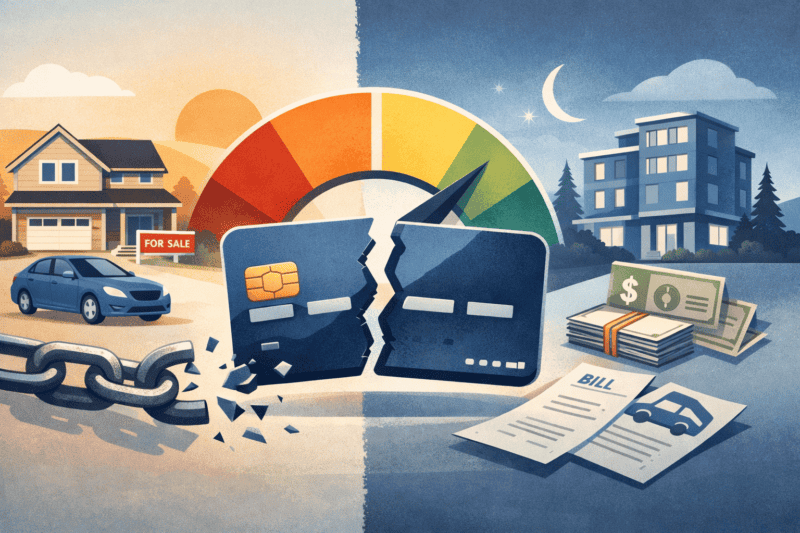
The key problem: divorce ends the marriage, not the debt
Here is the cold reality. Even an uncontested, cooperative divorce can still damage one or both spouses financially.
During marriage, many couples share checking and savings accounts, a mortgage, credit cards, car loans, and utilities
One spouse may have the credit cards in their name, the other may have the car loans, and the mortgage might be in both names.
A common misconception is that the divorce decree controls your relationship with the lender. It does not.
If your name is on a credit card, loan, or mortgage, the creditor can hold you responsible even if your divorce judgment says your ex must pay.
Why you ask? The lender was not a party to your divorce, and they do not have to follow the divorce decree, they made a contract with you before the divorce and it is still in effect!
That is why protecting your credit requires more than dividing debts on paper. It requires actually separating the accounts.
Ok great, bad news right? well not really. Here is a list of what you need to do if you are concerned about your credit during a divorce.
1) Get a full list of debts, accounts and amounts
You need to know every account you are responsible for, including the following!
Mortgage and home equity loans or HELOC
- Credit cards (including store cards)
Car loans and leases
Personal loans and lines of credit
Utilities and cell phone accounts
Any accounts where you are a co signer
- Student Loans (including any childrens you signed on)
A good starting point is pulling your credit reports. You can get free weekly online reports through AnnualCreditReport.com. (That is the official site.)
Tip: pull reports from all three bureaus. Accounts sometimes show up on one report but not the others.
2) Stop new joint debt from piling up
If you still have joint credit cards or joint lines of credit, new charges can keep building during the divorce.
Talk with your lawyer about whether you should and how to freeze, close, or limit joint accounts based on your situation and any temporary orders.
3) Separate joint credit cards and loans (the only guaranteed fix)
If a debt is joint, your credit is exposed until the account is no longer joint.An example is if your husband always paid the joint MasterCard but refuses now, that will impact your credit score as a late payment!
Practical options include:
Refinance into one spouse’s name (best option when possible)
Transfer the balance to an individual account (sometimes possible, often not)
Pay off and close the account
Close the account to new charges and set an agreed payment plan (only helps if both actually pay)
Important: “My ex will pay their half” is not a strategy. If payments are late, your credit takes the hit, even if your divorce papers say the debt is theirs.
4) Vehicles: retitle and refinance when needed
If both names are on the loan or the title, it is not finished when you decide “who gets the car.” To protect your credit, the vehicle usually needs:
Title transferred into the correct name, and
The loan is refinanced into the same person’s name (if the loan is joint)
If refinancing is not possible, selling the vehicle can be the cleanest option.
5) The house: decide early and be realistic
In many divorces, the mortgage is the biggest credit risk.
If one spouse keeps the house, they usually need to refinance to remove the other spouse from the mortgage. A quit-claim deed alone does not remove someone from the mortgage.
An assumption is possible in some cases, this is where the bank will let you “assume” the debt of the co-borrower, the bank has to agree, and in 2026, I’m only seeing a few banks actually allow this, but it’s worth asking your bank if you can.
If refinancing is not realistic, the options are usually:
Sell the home, or
Set a clear deadline to refinance, with a backup plan if it does not happen
(the backup plan usually includes a mandatory sale of the house)
If you are relying on your ex to refinance “later,” understand the risk. Until the refinance happens, your credit and your debt to income ratio can be affected.
6) Document everything
Keep a simple file (digital is fine) with:
Account statements
Screenshots or notes of calls with lenders
Payment confirmations
Dates, names, and what was said
Most people never need it. When you do need it, it matters to be able to give it to your lawyer..
Final Thoughts
Divorce is emotionally exhausting. Money and credit issues often make it worse, and they can follow you for years if joint debts are not properly separated and you’ve developed a plan to deal with this.
If you take one thing from this article, make it this: your divorce decree does not protect your credit score unless the accounts are actually divided, refinanced, or closed.
Information obtained in mankatofamilylaw.com may contain knowledgeable content about Minnesota Family Law that may be considered beneficial to some; however, in no way should this website or its contents be considered legal advice. Mr. Kohlmeyer is a Minnesota licensed Attorney and cannot provide legal services or guidance to those outside of Minnesota. If you wish to retain Mr. Kohlmeyer as your Attorney in your Family Law matter, contact 507-625-5000.
}

Really useful post. Even though things don’t translate directly over the Atlantic this is a handy checklist for my clients.
Thanks