
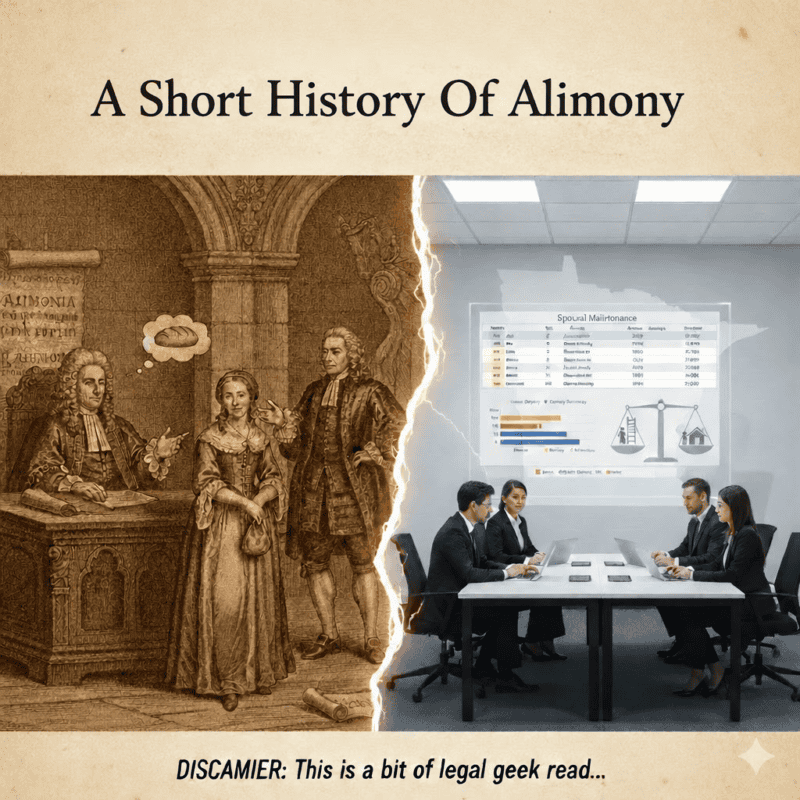
Or A MN Divorce Lawyer Went Down The Rabbithole of The History of Alimony…
DISCLAIMER: This is a bit of a legal geek read. This article will not help you if you’re getting divorced or paying spousal support; this is just an article I wrote together after researching Alimony in the US.
Alimony has been a feature of American law for as long as Americans have been untying the knot with Great Britain, but the logic behind the concept of alimony has shapeshifted dramatically.
At various points in history, alimony has been framed as a moral duty, a substitute for property, a tool for fairness, and a bridge to independence. Its evolution tracks the seismic shifts in American life, from the rigid gender roles of the 1600s to the economic partnerships of the 2020s.
The Ecclesiastical Hangover
American alimony began as a British import, borrowed straight from the ecclesiastical courts of England. In that era, divorce as we know it today, a complete dissolution of the marriage, allowing you to remarry, was practically unheard of. The courts generally only granted a “divorce a mensa et thoro” (separation from bed and board).
Because the marriage remained legally intact, so did the husband’s duty to support his wife (and children). This logic was solidified in English cases like Manby v. Scott in 1659, which established that a husband had a non-negotiable duty to provide “necessaries” to his wife. It wasn’t generosity; it was a legal requirement to keep the family structure on life support.
WORD HISTORY: the word itself comes from the latin word Alumnus, which the root of it means ” to nourish” or to eat. which the courts in England simply adopted the Latin word (as they were wont to do) to mean giving food to your (sort of) ex-wife.
Coverture and the Erasure of Identity
To understand why early American courts enforced this so strictly, you have to look at the doctrine of “coverture.” As famously explained by William Blackstone in his 1765 Commentaries on the Laws of England, the legal identity of a woman was suspended during marriage and consolidated into that of her husband.

Under coverture, a wife couldn’t own property or keep her own wages. If the couple separated, alimony wasn’t a “benefit” it was literally the only thing standing between a woman and starvation.
Since the law had stripped her of the ability to hold or build wealth or property, the law had to force the husband to maintain her.
The Morality Play of the 19th Century
As the United States matured and began establishing more states and adopting its own legal system (our basis is the English Common Law system, even today), divorce became slightly more accessible, but it remained a morality play.
This was the “Fault Era.” Legal scholars like Joel Prentiss Bishop of Massachusetts, whose 1852 treatise Commentaries on the Law of Marriage and Divorce defined the era, framed alimony as an “enforcement of duty”.
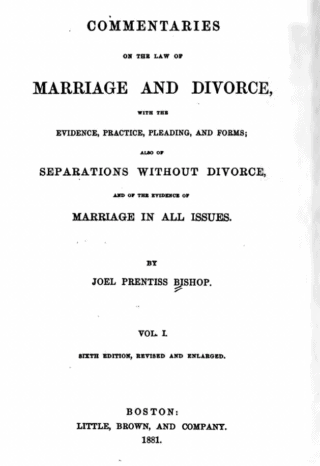
Courts used alimony as a behavior modification tool. If a wife was found “guilty” of adultery, she often received nothing, regardless of her financial state. If a husband was “guilty” of cruelty or desertion, he paid. It was part compensation, part punishment, and entirely gendered.
The First Cracks in the System
The rationale began to fracture in 1848. That year, New York passed the Married Women’s Property Act, a legislative trend that swept across the country over the next few decades. These acts allowed married women to own property and control their own earnings.
This created a new legal tension. If a wife could own her own wallet, why was the husband still required to fill it? Remember this is about 70 years before women could vote in the United States, so to say this was a bit on the “big deal” side of things is a massive understatement.
The courts didn’t abandon alimony, but the justification shifted. It became less about the absolute incapacity of the wife and more about fairness. About recognizing that while women could work, they often hadn’t in order to stay home and care fo the children and home, usually to the benefit of the husband’s career.
Keep in mind the context, this was 1848, about 11% of women worked, the rest stayed home with their parents until married or lived with their husbands.
Which is important to keep in mind since even if women COULD work, the vast majority did not, so the idea of women supporting themselves was almost a bit academic at this stage of history, since so few actually did!
The No-Fault Revolution
Now hang on to your seats, we fast-forward about 120 years, and it’s a whole new world, about 40% of women worked in 1969. They could vote, they could own property! and even some of the things taken for granted today, such as a single woman living alone, was thought odd in 1969.
FUN FACT: In 1848, when women owning property became an idea that the US could get behind, nearly 0% of women had a college degree. Fast forward to 1969, when about 12% of American women had a degree, and you’ll see the times they are a-changing.
The modern era of alimony was born in California. In 1969, Governor Ronald Reagan signed the Family Law Act, which took effect in 1970 and introduced the concept of “no-fault” divorce. The requirement to prove adultery or cruelty vanished, replaced by “irreconcilable differences.”

This posed a problem for the old way of doing things. If women could own property, could work (and were), and now there was no such thing as legal “fault,” you couldn’t use alimony as a punishment for a husband’s misdeeds during the marriage.
The caused the focus to shift entirely to economic need and the ability to pay and realities of Gender equity in 1970 America.
The Uniform Marriage and Divorce Act of 1970 codified this new approach, suggesting that spousal maintenance should only be awarded if a spouse lacked sufficient property to support themselves.
It probably didn’t hurt that Governor Reagan was a small-government Republican who knew that the wife who did nothing wrong and was left by her husband, and had no resources to support herself, would likely be forced to turn to the government for help and support.
This era also gave birth to the concept we still use today, which is “rehabilitative or temporary alimony”. The idea that support could be a temporary bridge to self-sufficiency rather than a lifetime pension.
Fun Fact: Ronald Reagan allegedly told his son and a biographer that enacting no-fault divorce was one of the “biggest mistakes of his political life” and there is a push currenlty bring back fault as a concept in divorces (even in Minnesota) where the Judge can reward the faithful and dutiful spouse and punish the spouse for committing misdeeds during the marriage.
The End of Gender Bias
The final major structural change arrived in 1979 with the U.S. Supreme Court case Orr v. Orr. The Court struck down Alabama statutes that imposed alimony obligations only on husbands, ruling that such gender distinctions violated the Equal Protection Clause.
Legally, alimony became gender-neutral overnight. Culturally, we are still catching up, but the precedent established that marriage is an economic partnership of equals.
The modern concept now frames alimony almost exclusively as compensation for financial losses incurred during the marriage. The idea that, if the husband stayed home while the wife attended medical school and worked as a doctor for 20 years, he forwent numerous career opportunities and therefore needs compensation.
Minnesota got rid of No-Fault divorces in 1974 and actually cleaned up the alimony statute to get rid of any gender references in 1969. The current Minnesota spousal statute is gender and fault-neutral, focusing exclusively on financial equity and need.
Where We Are Today?
Today, we are left with a system that tries to balance all these histories at once. We have moved from Blackstone’s “unity of person” to an analysis of standard of living, career sacrifice, and future earning capacity.
Alimony no longer means a husband paying his wife, but is now gender neutral, and looks to balance what each party has given up to support a marriage.
There we go! Hopefully, you found it as interesting as I did learning about how Alimony became the law in the US!