
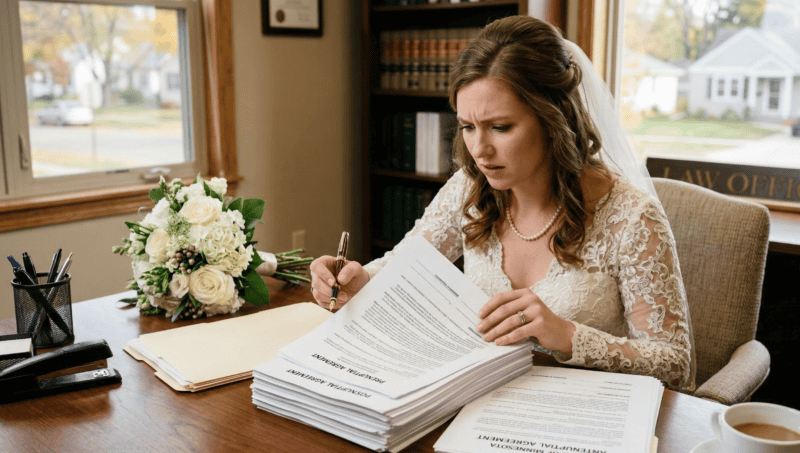
Do you need a Prenup?
It’s starting to move to Marriage season here in Minnesota. That means only one thing: prenuptial agreements! Most people avoid them because confronting the possibility of divorce feels like inviting it. That instinct is understandable. It’s also, from a practical standpoint, a mistake.
Consider what happens when a couple with a significant wealth disparity marries and later divorces without an agreement in place. The wealthier spouse brought substantial assets into the marriage, a business, investment accounts, an inheritance, and assumed those assets were safely theirs.
Under Minnesota law, that assumption is partially correct. Property acquired before marriage is generally classified as non-marital property under Minn. Stat. § 518.58 and is not subject to division in a divorce.
But “generally” is doing a lot of work in that sentence. Commingling assets, using marital income to service a pre-marital debt, or failing to maintain clear records can blur those lines quickly. That is where a prenuptial agreement does its real work, it lays out what everyone is bringing into the marriage!
What Is a Prenuptial Agreement Under Minnesota Law?
Minnesota law specifically authorizes prenuptial agreements — also called antenuptial agreements under Minn. Stat. § 519.11. The statute allows future spouses to contract with each other regarding their property rights during marriage and in the event of divorce, legal separation, or death.
A prenup is, at its core, a contract. It can define what property remains non-marital, how property acquired during the marriage will be classified and divided, what spousal maintenance rights either party does or does not have, and how debts are allocated. The parties can be creative, within limits. What a prenup cannot do is waive child support rights or make arrangements that a court would find unconscionable at the time of enforcement.
Minnesota law also recognizes postnuptial agreements under the same statute (contracts executed after the couple is already married) are allowed. These serve the same basic purposes and are subject to the same enforceability standards, though courts tend to scrutinize them a bit more closely because the power dynamics of an existing marriage can make it harder to establish that both parties genuinely negotiated at arm’s length.
Is a Prenup Unromantic? Yes. Is It Practical? Also Yes.
I have had this conversation many, many times in my office. One partner is well off, owns a business or farm, or is expecting an inheritance and wants a prenup. The other partner takes it personally, as if being asked to sign a contract before the wedding is evidence that their future spouse expects the marriage to fail.
I get it. But here is the analogy I always use: people write wills not because they want to die, but because they know that without one, the state will make decisions that may not reflect their wishes. A prenup works the same way. It is not pessimism. It is planning, and the great thing is that a well-thought-out prenup can actually save a LOT of money if you do get divorced.
Minnesota’s divorce rate, like the national average, hovers around fifty percent. That is a statistical reality, not a prophecy for any individual couple. But it does mean that a meaningful number of people who walk down the aisle will eventually sit across from each other in a courtroom, or at least across a conference table negotiating a settlement.
The time to define your financial expectations is before the wedding, when both parties are in good faith, motivated to reach a fair agreement, and not weighed down by the emotional weight of a dissolving marriage.
What Makes a Minnesota Prenuptial Agreement Enforceable?
This is where I see prenups go wrong. People download a template off the internet, both partners sign it the night before the wedding, and then assume they are protected. They are not. Prenups are not really that expensive to have a lawyer draft, a few thousand dollars typically, but they have to be very detailed.
Under Minn. Stat. § 519.11, there are clear requirements that must be met for a prenuptial agreement to be enforceable in a Minnesota court, and courts do scrutinize these agreements when a spouse challenges them at divorce.
First, both parties must make a full and fair disclosure of their earnings and property before signing. This means each spouse needs to know what the other actually has in terms of assets, income, debts, and financial obligations.
The disclosure does not have to be in writing under the statute, but in practice, putting it in writing is the only logical approach. An oral disclosure is nearly impossible to verify years later in court when one party inevitably claims it was inadequate.
Second, both parties must have had a reasonable opportunity to consult with independent legal counsel before signing. Note the word “independent”; each spouse should have their own attorney reviewing the agreement, not the same lawyer representing both sides.
The attorney drafting the agreement for the wealthier spouse cannot ethically represent the interests of the other spouse. This requirement protects both parties. If one spouse later claims they did not understand what they were signing, the fact that they had their own attorney goes a long way toward defeating that argument.
Third, and this is the timing piece that catches people off guard: Per the statute, you must sign it in front of two witnesses 7 days or more before the wedding ceremony. This is a big deal, no last minute pressur before the night of the wedding.
NOTE: The law changed in 2025, it had been 24 hours before the wedding, but now it’s 7 days before.
Finally, the agreement must be substantively fair at the time it was executed. Minnesota courts apply what amounts to a reasonableness test: the provisions must be ones that could reasonably be anticipated given the parties’ circumstances, and the agreement as a whole cannot be so one-sided as to be oppressive to one spouse.
This does not mean the agreement has to be perfectly equal; a prenup protecting a wealthy spouse’s business interests is entirely legitimate. But an agreement that strips one spouse of any rights whatsoever, including maintenance in a long marriage, is the kind of provision a court may refuse to enforce.
What Can (and Cannot) Go Into a Minnesota Prenuptial Agreement?
A well-drafted prenup can accomplish quite a bit. It can establish that a family business or its appreciation in value during the marriage remains non-marital property. It can define how the marital home will be handled if one party owned it before the marriage.
It can address spousal maintenance rights, either waiving them, capping them, or setting a formula. It can protect an expected inheritance or a structured settlement. It can even address how debts one spouse brings into the marriage will be handled, so that a spouse is not left holding liability for student loans or business debt they never benefited from.
What a prenup cannot do is set child custody arrangements or waive child support. Under Minnesota law, child support is a right that belongs to the child, not the parents, and parents cannot contract it away in advance. Courts will not honor those provisions.
Similarly, a prenup signed under duress, based on fraudulent financial disclosures, or lacking the procedural safeguards described above, will not hold up. I have seen wealthy clients who had prenups drafted by competent attorneys watch those agreements unravel in court because the procedural requirements were not followed carefully. The agreement itself matters, but so does how it was executed.
What About Postnuptial Agreements?
A postnuptial agreement serves the same basic purposes as a prenup but is executed after the couple is married. Minnesota authorizes these under the same statute. They can be useful in a number of situations: one spouse receives a large inheritance during the marriage and wants to formalize their non-marital status, a couple’s financial circumstances change dramatically due to one spouse launching a business, or a couple works through a crisis in the marriage and wants to restructure their financial relationship going forward.
The enforceability requirements are essentially the same as for prenups — full disclosure, independent counsel, and substantive fairness — but courts apply somewhat closer scrutiny to postnuptial agreements.
The concern is that one spouse may be in a weaker bargaining position within an existing marriage, particularly if the marriage is already troubled. If one spouse is being pressured to sign a postnup under the implicit threat that the marriage will otherwise end, that is exactly the kind of coercion that undermines enforceability. Both parties need to enter the agreement genuinely voluntarily, with full information and adequate legal representation.
FUN FACT: This is one of the few areas of the law that requires each party have a lawyer.
Practical Advice If You Are Considering a Prenup in Minnesota
Start early. The worst prenuptial agreements are the ones negotiated in the last few weeks before a wedding, when one or both parties feel pressured, there is not enough time for careful review, and the emotional stakes are highest.
Bring an attorney into the conversation as early as possible, ideally months before the wedding. The attorney drafting the agreement should represent the party whose assets are being protected. The other party should retain separate counsel to review the agreement independently. Yes, this costs more. It is worth it.
Make the financial disclosures thorough and in writing. Attach asset schedules and income documentation as exhibits to the agreement. Courts look favorably on prenups where the disclosures are specific, contemporaneous, and verifiable.
“I told him about my accounts” is a weak foundation for enforceability compared to a signed schedule listing every account and its approximate balance.
Revisit the agreement if circumstances change significantly. A prenup that made sense when both parties were in their thirties with modest assets may not adequately address the situation twenty years later when one spouse has built a successful business and the other has been the primary caregiver for their children.
Some couples include review clauses in their prenups. Others simply choose to execute a postnuptial amendment. The important thing is not to assume that what you signed before the wedding will still be the right agreement for your circumstances a decade in.
The Bottom Line
A prenuptial or postnuptial agreement is not a statement of distrust. It is a statement that both parties are adults who understand their financial situation and have taken the time to define their expectations clearly. That kind of clarity, reached voluntarily and with full information, is actually a pretty healthy foundation for a marriage.
If you are considering a prenuptial or postnuptial agreement in Minnesota, or if you are heading into a divorce and believe an existing agreement may be unenforceable, I would encourage you to reach out to KH Law.